

Mastering Time: From Busy to Balanced
How to Honestly Evaluate, Optimize, and Embrace Your Time for a More Fulfilling Life

There are three stages to positively impacting your relationship with time: honesty with yourself about how you spend it, making the most of what you’ve got, and accepting that there will never be as much of it as you’d like.
Stage 1: Honesty
One of the hardest things about “finding” time is that it can be uncomfortable to look for it. Have you ever stopped to really look at how you’re spending it? Imagine if I told you every minute of how you spent your day yesterday had been recorded, totaled, and sorted into brutally honest categories, and these results had been sent out to everyone you know.
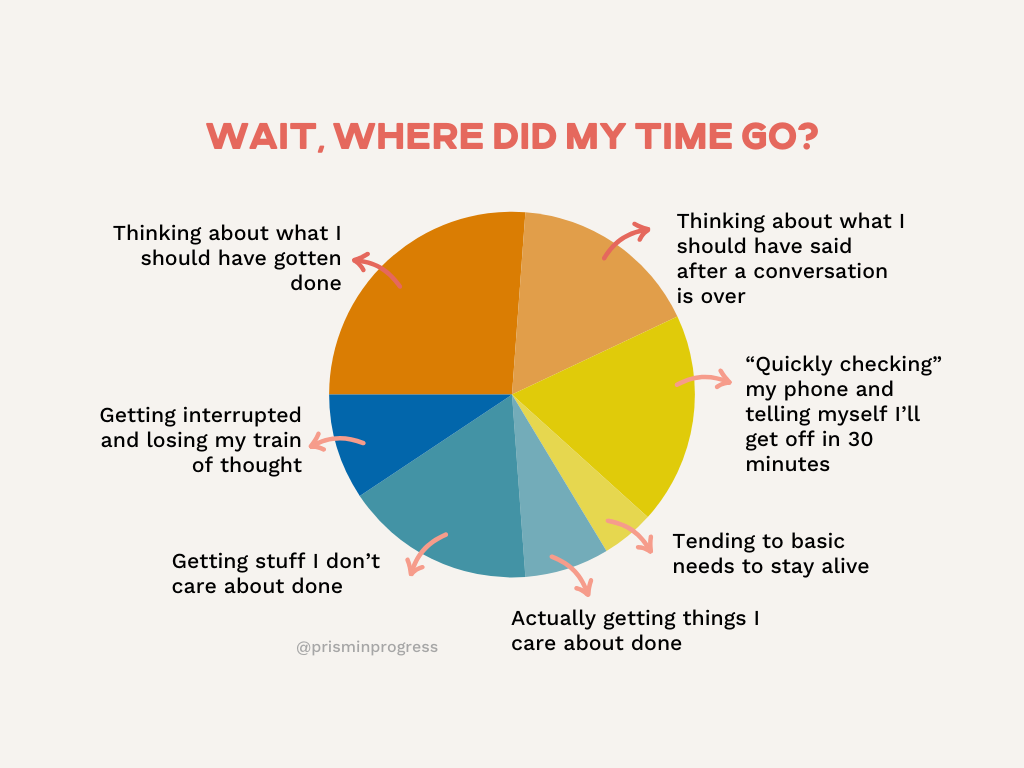
If you started sweating a little bit, congratulations, you passed the AI test, and you’re human - most of us feel guilt about how we “should” spend our time vs. how we spend it. But to “find” time, we have to be honest with ourselves about how we’re spending it.
Rather than judging it, let’s understand its impacts and focus on how we want to shift it.
How to Overcome Stage 1
Perform a time and energy audit over the course of a typical week.
Keep it simple and make high-level notes on how you spend your mornings, afternoons, and evenings.
Rate your energy level after each activity.
Let your phone do some of the work for you. Enable screen time tracking and add it as a widget to your Home screen (iPhone instructions and Android instructions). This will automatically tell you how much time you spend on apps and websites, even how many times you picked up the device.
Did how you spent your time align with your priorities?
What took more time than you expected? What took less time?
What left you feeling more energized? What left you feeling more drained?
Where could you make shifts?
Stage 2: Optimization
“How can I feel so busy but so unproductive at the same time?” Once we have a clear view of how we are spending the time we have, it’s time to explore ways to use it as effectively as possible.
These are some of the most common issues I see with time management:
We’re really not that good at estimating how long things take.
An unspoken rule in project management is to never take someone's estimate of how long a task will take them at face value. You watch for patterns and start to learn where people tend to over- and underestimate. Your job is to think about all the ways their time is eaten up outside of what they intend to do. A task that takes 4 uninterrupted hours - what does that realistically look like for a person constantly getting emails, "Hey, quick question" Teams messages, and desk drop-bys?
We try to do things at the wrong times.
According to science, we have genetic predispositions to feel more energetic at different times of day (these are called chronotypes and are where the terms “early bird” and “night owl” come from). Evidence also shows we can impact these dispositions through our habits and behaviors. Whether through your genetics or through your lifestyle, there are times of day when you are more efficient at specific activities.
We only focus on the short game.
Answering the emails as they come in, responding to every request, doing the chore that could have waited until tomorrow - these feel like accomplishments in the moment, but can keep you from making meaningful progress on things that would have a bigger impact. Putting out fires quickly becomes a full-time job if you don’t spend any time stopping what is starting them.
We under- or over-plan.
A lack of planning creates a lack of direction for focusing the full power of our energy. The process of planning prepares us for how to handle things we might not have anticipated. It helps us orient our days and weeks in service of larger goals. But a plan shouldn’t become a prison. Excessive planning puts us in a freeze state, makes us less willing to make adjustments when it’s not working, and more likely to waste time defending it because we’re too attached to certain outcomes.
How to Overcome Stage 2
To become a better estimator, you need data on what you are struggling to estimate correctly. Tracking planned vs. actual time on tasks is the ultimate reality check. You also need to ensure you’ve thought through any dependencies. Do you have everything required to start? Will completing the task require anyone else? Will you be interrupted? Can anything be done concurrently? What is the best order of operations for what I’m trying to accomplish? What else might impact the time it takes?
Where you have the flexibility, organize your day in alignment with your energy. When are you most focused and efficient? Most creative and innovative? Most checked out? The wrong task at the wrong time can easily waste more time than just waiting.
Don’t waste your most focused hours on tasks that don’t align with your priorities or move the needle on your larger goals. It might feel good to take advantage of high energy to knock out a ton of mindless tasks, but quantity doesn’t equal impact. When we get caught up in the short game, it’s easy to lose sight of the long game and be left feeling like we never get any real traction.
Establish 1-3 guiding goals for the day or the week to help you prioritize your time. These are the most important things for you to accomplish that align with your priorities. The intent is to create a list that is aspirational but attainable, creates a clear direction without bogging you down in unnecessary detail, and allows you the space to be flexible with the unexpected.
Stage 3: Acceptance
In the scope of this lifetime, there will never be enough time for every possibility, for every scenario, for everything you could do. And even if we could have more time, would that really be the answer?
We are given a finite amount of time, so that in its scarcity we can learn to appreciate it. The fact that you don’t have endless time to get everything done is what makes life meaningful. With the time you have, you get to choose how to spend it. The act of prioritizing is an expression of how much you value the time you have.
How to Overcome Stage 3
More is not more. Prioritize what really matters to you and focus on impact over quantity.
Instead of lamenting the time we don’t have, focus on finding ways to appreciate the time we do have. Write down and say out loud what you are grateful for.
Create a life you enjoy!
Want to go deeper? Learn about ways to work with me.
Takeaways + Tools + Prompts
Be Honest About Your Time: The first step to managing your time effectively is being brutally honest with yourself about how you currently spend it. Conduct a time and energy audit to gain clarity on where your time goes and how it impacts you.
Optimize Your Schedule: Align your tasks with your natural energy levels and focus on high-impact activities. Use the data from your time audit to better estimate task durations and plan your day.
Focus on the Long Game: Avoid getting caught up in short-term tasks that offer less progress toward your larger goals. Prioritize activities that truly move the needle and help you achieve more meaningful outcomes.
Embrace Time Scarcity: Accept that there will never be enough time to do everything. Prioritize what truly matters, appreciate the time you have, and focus on creating a life you enjoy.
Balance Planning and Flexibility: Planning is essential for direction and focus, but it’s important to remain flexible. Set 1-3 guiding goals each week that align with your priorities without overcomplicating things.
Meditative Prompt
Find a quiet space where you can sit comfortably without distractions. Close your eyes, take a few deep breaths, and allow your body to relax. As you settle into the moment, take time to reflect on the following:
Reflect on Your Day: Visualize how you spent your time today. What activities filled your time? How did each activity make you feel? Were there moments when you felt rushed or stressed? Were there times when you felt calm or energized?
Identify Your Priorities: Now, think about the activities that brought you the most joy, satisfaction, or fulfillment. Were these activities aligned with your priorities? What tasks felt meaningful, and what felt like busy work?
Visualize a Balanced Day: Imagine a day where your time is perfectly balanced - you’re focused on what truly matters to you. Picture yourself moving through the day fully engaged in each moment without feeling overwhelmed or pressured.
Embrace Acceptance: Acknowledge that there will never be enough time to do everything. Instead of feeling frustrated, choose to feel grateful for the time you have. Reflect on the idea that time’s scarcity gives it value and meaning.
Set an Intention: Set a clear intention for how you want to spend your time moving forward. What small changes can you make to align your daily routine with your priorities? How will you remind yourself to focus on impact over quantity?
Creative Project Prompt
Write a letter to your future self detailing your current hopes, dreams, and expectations. Seal it and set a reminder to open it in a year.
/ or /
Design a piece of art that you can seal and reopen in a year. Include visual and written elements that capture your current state and future aspirations.
…or do both.